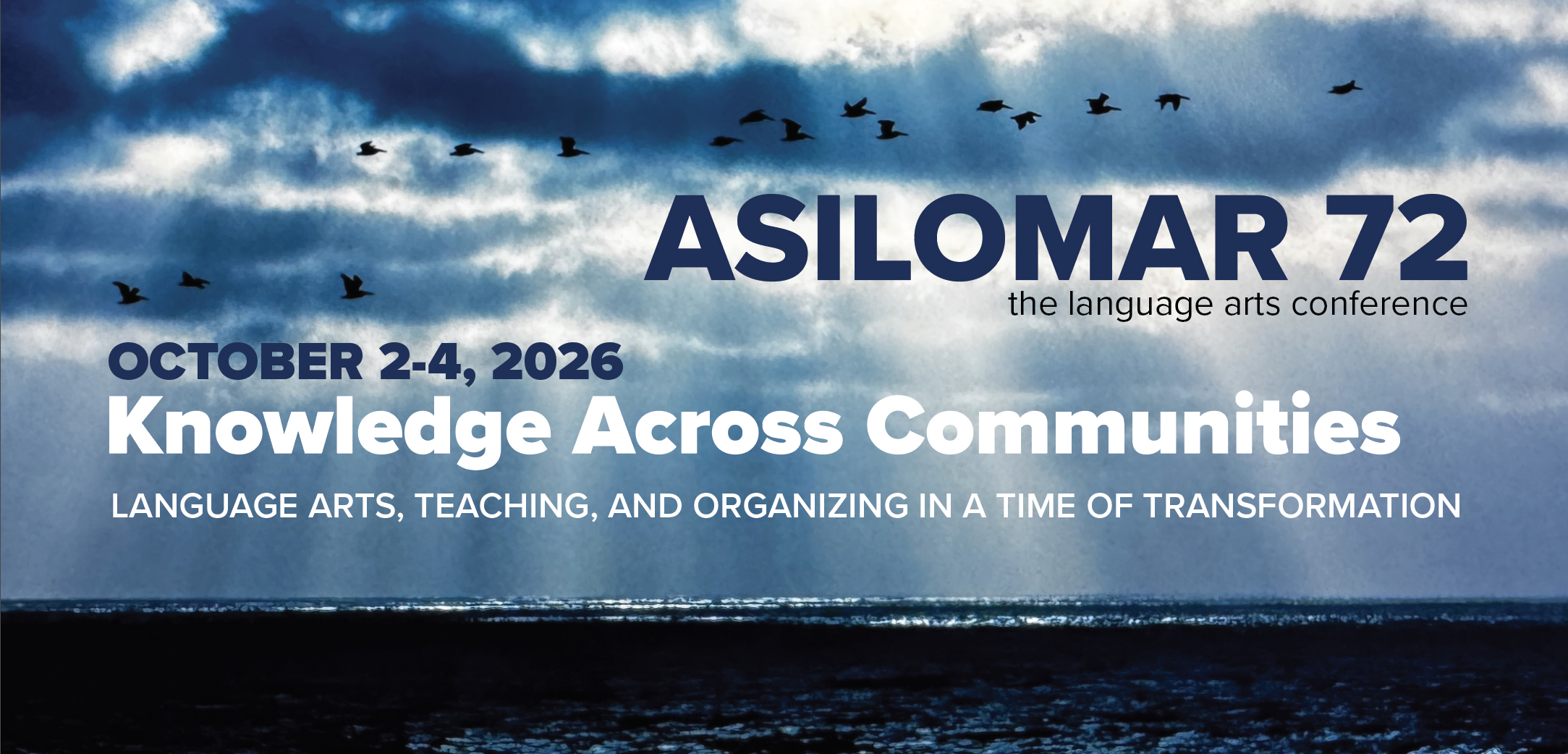
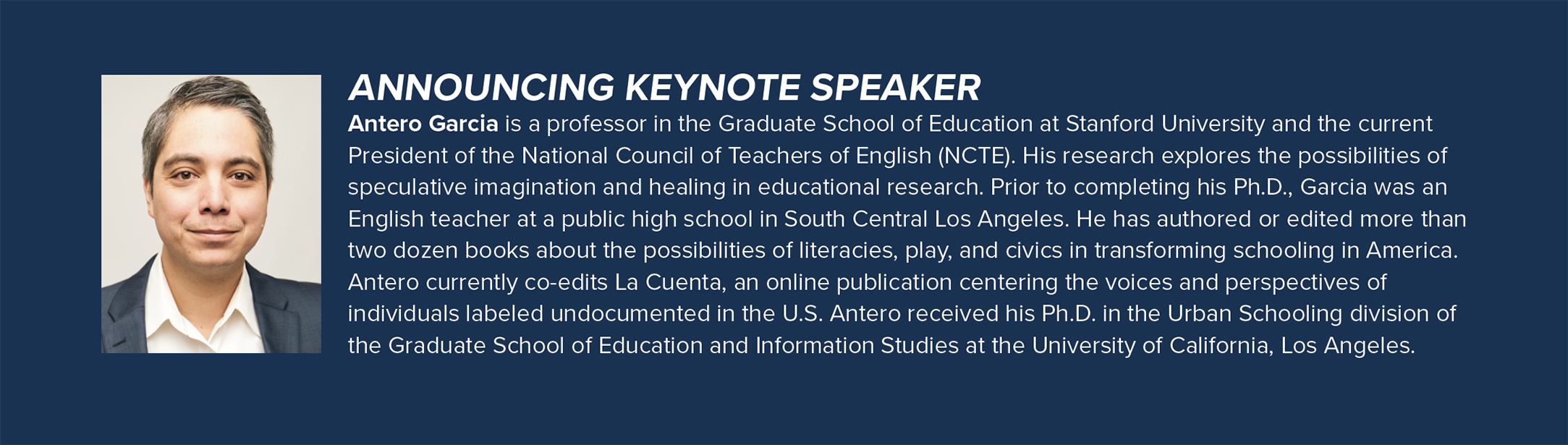

For over 75 years, the Asilomar Conference has united educators to advance English Language Arts through collaboration and shared expertise. This year’s theme, Language Across Communities, centers on how educators, writers, and organizers build and share knowledge within and across communities—classrooms, families, cultures, institutions, disciplines, and geographies—to address the transformative challenges facing education today.
As we navigate an era of profound educational transformation, we recognize that the most powerful knowledge emerges when communities connect, share wisdom, and collaborate across differences. From rural classrooms to urban centers, from traditional kindergarten to college composition practices that honor multiple knowledge systems and cultural ways of knowing, from student voices to family knowledge systems—transformation happens when we bridge divides and learn from one another and with each other.

GRADES 6-12, COLLEGE, GENERAL ENRICHMENT
Freedom of expression is vital, but not unlimited. Speech can inform or harm, uplift or wound. This interactive workshop uses creative theater strategies to help students critically explore the power, boundaries, and responsibilities of free speech in a diverse, democratic society.
The Problem
Students in a Journalism II class at Hazelwood East High School in St. Louis, Missouri wrote stories about their peers’ experiences with teenage marriage, runaways, teenage pregnancy and the effects of divorce on children. The topics had been suggested by journalism students in the fall of 1988, and were written under the supervision of a faculty advisor for publication in a special two-page section of the school's newspaper, The Spectrum (Wicentowski, 2022). The principal read it before publication and pulled it, saying: "This is too personal. Some students are identifiable. Parents will be upset." The student journalists claimed "This is censorship. These are our stories. We have a right to tell them.” When they published the articles in the school-sponsored and funded newspaper the principal deleted the pages that contained the stories prior to publication without telling the students. Cathy Kuhlmeier and two other former Hazelwood East journalism students brought the case to court.
Claiming that the school violated their First Amendment rights, the students took their case to the U.S. District Court for the Eastern District of Missouri in St. Louis. This case came to be known as Hazelwood v. Kuhlmeier. The trial court ruled that the school had the authority to remove articles that were written as part of a class.
The Challenge We Face
This case demonstrates the paradox of free speech. While freedom of expression is a foundational human right—it’s enshrined in international law and our Constitution—we want students to understand its importance, to value it, and to exercise it. But free speech isn’t absolute. It has boundaries, which are very difficult (murky, contested, genuinely difficult). Speech can harm. It can invade privacy, spread lies, incite violence, or wound vulnerable people. As teachers, we must help students understand both the power of free expression and the responsibility that comes with it.
Using Drama for Embodied Understanding
The problem is that traditional approaches often fail us here. Classroom debates about controversial speech tend to entrench existing positions rather than expand understanding. What we need is embodied understanding—the kind that comes from genuinely inhabiting another person’s position, feeling the weight of their concerns, speaking their truth even when it conflicts with your own.
This is where drama comes in—as a tool that can do what other approaches do not: put students into others’ shoes, requiring them to understand other perspectives deeply enough to perform them convincingly. This workshop brings “others’ shoes” to life for the purpose of bringing the abstract principle of free speech to life.
Reading Strategies Play a Role
Participants will be guided through the steps of reading as an actor, as a designer, and as a director with the story of Hazelwood v. Kuhlmeier in mind. These reading steps involve delving into the back story of the characters, filling in time gaps in the story line, building a representation of the narrative’s setting in the classroom, and enacting the story’s sequence of actions within that environment. (Note, this process can be successful with any free speech issue.) You will see how completing these tasks gives readers a structure through which to understand characters backgrounds and relationships, more clearly comprehend the continuity of a story, and identify how and why the actions progress from the beginning to the end. Through this process, readers do not “study” a text, but “inhabit” it, realizing the meaning of the language as they use the words to achieve their characters’ objectives, comprehending the era in which the story is set through embodying its behaviors, and understanding the action of the story by experiencing it.
GRADES 6-12
Can educators still teach "troubling" but worthwhile texts? Culture wars and cancellations have shrunk reading lists, and created ethical dilemmas. This session explores literature’s enduring power and responsible ways to teach challenged books. Participants will confront classroom controversies and share practical, student-centered approaches to teaching the texts we believe in.
GRADES K-6
This session supports elementary teachers in integrating ELA and Ethnic Studies through identity-affirming, culturally sustaining practices. Educators learn to create safe, brave classrooms; co-construct inquiry and writing with students; engage families and communities; and apply the five S’s and Hallmarks of Ethnic Studies to foster learning.
Infusing ELA and Ethnic studies in an elementary classroom means using a critical lens and affirming students’ identities and wealth of knowledge. Ethnic studies in the elementary classroom centers historically marginalized voices to build collective determination, critical hope, and liberation by challenging white supremacy culture through affirming stories and community knowledge. Using a critical lens, teachers create equitable, welcoming environments by co-creating community agreements, designing inquiry units rooted in self-affirmation, and integrating community cultural wealth. Through the five S’s, teachers and students challenge dominant narratives, explore identity, collaborate, communicate to authentic audiences, and reflect on collective action, using genre writing, poetry, visual arts, opinion, and persuasive writing to create meaningful, sustainable change in their communities. This is a liberatory approach to dismantle and decolonize white supremacy culture in the curriculum and classroom culture.
GRADES 6-8
Rereading your own writing can be transformative. This session explores ways to draw students in, boost motivation, reinforce effective practices, and keep teaching joyful, humorous, and alive. Participants will experience strategies that help writers reflect on work and view it in a new light, fostering engagement and growth.
GRADES K-12, COLLEGE, GENERAL ENRICHMENT
By pooling our professional wisdom to address student disengagement, we will co-create responsive instructional practices that foster deep belonging and student agency. Through interactive demonstrations, we’ll brainstorm "two-legged" designs balancing academic progress and well-being. Join us to launch your own renovation project, creating inviting, nourishing learning experiences for all students.
When your roof leaks in one or two places, it may just need repairing. If each year it springs more leaks, chances are it’s time for a new or redesigned roof. In May 2025, California English editor Carol Jago marked a significant worsening of disengagement over the previous year: "Teachers across the country are reporting that their students are disaffected, disengaged from school, barely putting in seat time, stuck in neutral" (5).
In this session we start by assuming that when it comes to students’ spiraling disengagement in school the elephant in the room is our outdated idea of what curriculum is. Curriculum today is a failing roof exposing our students to the elements. How is it every year they are more exposed, more stuck in neutral? Something essential is missing in our conception of curriculum. In recent years this lack is showing up in our students with compounding effects.
The project of re-engaging students can only truly begin as we renovate our notion of curriculum to reflect the reality that we and our students are not static empty vessels but developing beings.
What would a curriculum that nourishes young people’s full development look like? Could it revive their engagement in learning? Would such a curriculum be the umbrella that naturally brings together the range of valuable approaches we are now deploying to restore lost engagement: building fuller, more authentic relationships with students, making learning relevant and inviting to all student communities, offering choice and autonomy, prioritizing mental health and basic needs? If we find that evolving and introducing developmentally nourishing curricula supports us in meeting multiple such needs, essentially by redesigning and renewing the roof, might this be our best hope of newly engaging our young in learning -- elevating their well-being in the process? These are some of the questions we’ll consider in our session’s conversations.
In this innovative, interactive session, we will:
> open the conversation by reflecting on two demonstrations of developmentally nourishing learning experiences that point to a “two-legged” design of curriculum.
> contemplate a long-considered set of understandings from established developmentalist-educators about child development that a) illuminates children’s innate needs in each period of their development, and b) suggests how teachers, parents and other adults in their lives can nourish those needs.
> consider in pairs or teams what students say about how they experience learning in a two-legged course designed to balance support for academic progress with nourishment for developmental needs -- particularly its effects on developing writing, reading, and conversation skills.
> divide into teams according to our roles in education to brainstorm how we can apply what we’ve learned in this session, with classroom teachers launching plans to renovate our own practices of curriculum and instruction.
> consider Resource Person's invitations to connect further in collaboration to create next steps for teachers, families, departments, schools or districts
GRADES 9-12
Algorithm-driven feeds and AI create conflicting realities for students, demanding new pedagogical responses. By pooling our professional wisdom, we will explore library-classroom collaborations that empower critical literacy. Join us to investigate media literacy as a bridge between communities, sharing practical strategies that help students responsibly navigate their digital lives.
In a world shaped by algorithm-driven feeds, digital echo chambers, and AI-generated content, students often navigate multiple, sometimes conflicting realities. How can libraries and classrooms work together to help students critically evaluate information, understand media influences, and build authentic knowledge communities?
In this session, participants will explore media literacy through the lens of library–classroom collaboration. Drawing on lessons implemented with English teachers in my district, we will examine strategies including lateral reading, news literacy, and the ethical use and analysis of AI-generated images. We will also delve into the role of algorithms in shaping what students see, read, and believe, and consider how library and classroom resources can support critical inquiry.
Through hands-on exploration and collaborative discussion, attendees will develop practical approaches for helping students navigate information responsibly, think critically about media sources, and connect classroom learning to broader community knowledge. This session emphasizes real-world collaboration between librarians and teachers as a model for fostering critical literacy and bridging divides in students’ digital and academic lives.
GRADES K-12
Sharing classroom-tested knowledge, we explore an inquiry template for researching local Indigenous histories. Together, we’ll identify problems and propose remedies, creating a student-centered curriculum that honors community roots while building research skills. We investigate Native American history, culture, and present-day tribal practices across grade levels and diverse school disciplines.
GRADES 6-12
Sharing classroom-tested knowledge, we’ll challenge "perpetual foreigner" myths through Vietnamese American memoirs and primary sources. This session explores interdisciplinary toolkits offering "windows and mirrors" for students. Join us to co-create practical strategies that expand American identity, fostering belonging and empathy in our classrooms and the wider community now.
GRADES 6-12, COLLEGE
Rooted in James Moffett’s legacy, Cross Cultural Fluency fosters cultural diplomacy through "twinned teams." Students link in written English with peers abroad, sharing responses to shared lessons: poems, athletic experiences, or local dishes. Join us to explore this tested pedagogy, bridging different worlds to build remarkable global common ground.
Cross Cultural Fluency derives from James Moffett's 1990s book Harmonic Learning. The pedagogy became operational at sites in California and Nevada. Classroom teachers from GR 6-8, Senior, and Higher Education had their students link in written English with students of teachers abroad, forming twinned teams to share responses to the same lessons, to a poem, an athletic experience, or a dish, thereby bringing different worlds together. Teams there included students from France, Morocco, China, Bali, Nigeria, Egypt, and other countries.
This innovation resulted in remarkable personal insights, replications, and expanded common ground worldwide.
GRADES 6-12, COLLEGE, GENERAL ENRICHMENT
This session focuses on using AI to build curriculum, save time, and strengthen instruction—without panic or hype. Participants will see real examples of how teachers use AI to design units, create lessons, generate assessments, differentiate instruction, and improve feedback. We’ll break down basic AI terms, explain what tools like ChatGPT actually do, and show/practice how to write effective prompts. We’ll also tackle the big question—will AI replace teachers?—and explain why teaching still requires human judgment and connection. A major portion of the session looks at student AI use: how to move from banning it to guiding it, using AI as a thinking tool rather than a shortcut. Participants will leave with strategies like AI-use statements, process checkpoints, source-bound AI tools, and assignment designs. Ultimately, this session will deliver practical ideas instructors can use immediately.
Note: Participants will need to bring a laptop for this session.
GRADES 6-12
Looking for a systematic way to improve instruction? This session explores teacher inquiry groups grounded in a teacher-led, two-group quantitative study. Learn to design research, and collect data to impact students and communities. Join us to identify problems, propose remedies, and reclaim your professional voice as a transformative teacher-researcher.
GRADES 9-12, COLLEGE, GENERAL ENRICHMENT
This session explores a conceptual framework to help teachers create spaces of authentic connection through ELA units and support teaching across racial differences. Participants will develop strategies for building critical literacies that interrogate difference, examine nuanced shared histories, and support students in imagining cross-cultural solidarities and collective action.
*The Problem/ Context *
We currently live in particularly unsettling times.
I could not help but think about Lorde’s words: Your silence will not protect you. Trump’s Executive Orders banning DEI programs on January 20, 2025, and “radical indoctrination” in K-12 schools on January 29, 2025, made it painfully clear that when our government and institutions ban diversity and inclusion efforts, they are not simply rejecting a set of policies—they are actively working to silence conversations about race, identity, and justice. It is also an attempt to erase history, to make people believe that if we stop talking about oppression, it will cease to exist. However, as Lorde (1977) reminded us, refusing to speak out does not keep us safe. It only strengthens the very forces that seek to erase us. Therefore, it is ever more important to recognize that using our voices, whether through advocacy, education, or everyday conversations, is not just important. It is survival.
I also recognize that the current political climate marked by anti-critical race theory (CRT) rhetoric; the banning of books in K-12 education; the removal of diversity, equity, and inclusion (DEI) legislation in public institutions; and accusations of “radical indoctrination“ is not an isolated moment in history. Rather, it is part of a recurring pattern, a pendulum that swings in response to racial progress in America. Each step forward toward racial justice has historically been met with resistance, as those in power attempt to suppress conversations and policies that challenge systemic inequalities.
*The Challenge Educators Face*
Freire (1993) advocated for dialogue in the classroom space between teachers and students so that learning is a joint responsibility. However, dialogue is not necessarily only about talk. As educators, we need not only to “hear,” but also to interpret the various silences of students; otherwise, we might continue to conduct teaching with ignorance (Bao, 2021). Bao (2014) acknowledged that although speaking is an essential skill in dialogue, employing and understanding the complexities of silences are other skills for effective dialogue. As a result, educators need to develop the skills to attune to and interpret silences and must be aware of their students’ moments of silences and ask why.
Especially in times when division is sown among communities, how do we listen with deep empathy across differences? How do we “mine and mind the silences”, the unspoken tensions that shape our interactions, and engage in the difficult, necessary conversations that move us toward understanding and connection? Through literature, and the intentional construction of connections to political, cultural, and linguistic contexts, English teachers are uniquely positioned to learn alongside students what it means to be human. In this role, teachers can support students in navigating their relationships with others and cultivating empathy, particularly in moments when verbal language might fail (Mirra, 2018).
*Thick Solidarities: Conceptual to Classroom Practice*
Drawing on the conceptual framework of thick solidarity (Liu & Shange, 2018), this session argues that ELA classrooms can serve as vital sites for collective meaning-making, historical truth-telling, and relational repair across differences, particularly during what many scholars describe as dangerous and dehumanizing times.
Liu and Shange (2018) developed the concept of thick solidarity in how we can begin thinking about the ways we can shape discussions and build such literacies with our students in the classroom. They defined it as a radical belief in the inherent value of each other’s lives, despite never being able to fully understand or fully share in the experience of those lives“ (p. 190). The concept of “thick solidarity” advocates for empathy that does not overlook the differences of racialized experiences, but rather “pushes into the specificity, irreducibility, and incommensurability of racialized experiences” (p.190). Using sample units, this session will examine how these connections are constructed and provide space for educators to engage in dialogue about pedagogical approaches that support meaningful connections across different communities.
*Participant Engagement*
Participants will be introduced to the concept of “thick solidarity” (Liu & Shange, 2018) and also from Archaeology of the Self (Sealey-Ruiz, 2022) to see how these conceptual frameworks allow us to examine our own established units and how we can purposefully create textual connections that allow our students to establish a deeper understanding towards not only racial differences, but also a deeper understanding towards a particular community (If possible, I plan to showcase The Magic Fish Unit and From a Whisper to a Rallying Cry Unit).
Drawing on examples of students’ discussions, writing, and assessment work, attendees will examine new approaches to pairing fiction and nonfiction texts, assessing literature as a site of advocacy and activism, and designing assessments that engage students with the contemporary world. Participants will also develop greater pedagogical awareness of how to intentionally cultivate spaces for a pedagogy of connections in a GR 9-12 ELA to higher ed classrooms.
GRADES 9-12, GENERAL ENRICHMENT
Thich Nhat Hanh reminds us that creating peace begins with the self. This session explores powerful, multigenre writing practices supporting students in cultivating peace and resisting violence. By centering healing, empathy, love, and hope, we’ll share practical classroom applications to identify problems and propose remedies, fostering collective professional wisdom.
GRADES 9-12
Teenagers today love listening to, interpreting and memorizing lyrics to songs. In doing so, they are building literary and literacy skills without realizing it. This session explores ways to employ students' natural interest in multi-cultural, multi-genred music as a bridge toward improving thinking, reading, and writing skills.
GRADES 6-12
The Silk Roads isn't just for history class! Discover how this ancient network of exchange fueled centuries of vibrant literature. In this hands-on session, you’ll dive into a curated toolkit of literary resources and lesson plans designed by teachers who have walked the route. Explore unique texts and authentic primary sources while collaborating on lessons that will captivate your students. Leave with fresh, authentic materials and a ready-to-teach lesson plan of your own. Optional readings will be available for early birds, but all you need to bring is your creativity.
GRADES K-12, COLLEGE, GENERAL ENRICHMENT
Join us as we explore the transformative power of writing! In this workshop, participants engage in a non-threatening writing process developed by the Bay Area Writing Project which transfers easily to the classroom. We remember the thrills and challenges of writing, and explore methods for sharing and revising early drafts. On Saturday morning, participants work independently (“on the road”), creating memoirs, essays, poetry, or fiction. Later, we gather in small groups to read our work and offer positive feedback. On Sunday, we regroup to enjoy each other’s creations and celebrate the creative journey.
GENERAL ENRICHMENT
This session aims to have an internal interrogation of how we, as educators, are the very accomplices to preserving an anti-Black culture through English language arts. Through discussions and explorations with frameworks of power, coupled with curated passages from James Baldwin's 1963 speech "A Talk to Teachers," participants will explore how our own journeys in American education systems are what have conditioned us to perpetuate dominant norms, therefore influencing how each new generation of students may do the same. The first half of this workshop will focus on the frameworks of power and dominant norm behaviors to allow for us to more fully interact with Baldwin's concepts of not just anti-Blackness, but the dependence upon the myths surrounding our conventional definitions of education, literacy, and self-worth.
GRADES 6-12, COLLEGE
The emergence of AI has challenged how we conceive, produce, and teach the written word. This session invites educators to navigate the ethics of AI, reimagine pedagogical best practices, and explore emerging tools, all while preserving the essential human elements of voice, agency, and critical inquiry.
GRADES 6-12
This session explores the Active View of Reading, moving beyond traditional models. We’ll examine executive functioning as the engine driving comprehension. Participants explore research and hands-on strategies to support all readers. Utilize this framework as a pragmatic tool to empower growth, identifying problems and proposing remedies for striving readers.
GRADES 9-12
This immersive weekend session invites educators to evolve their practice by moving beyond the Simple View of Reading to embrace the Active View of Reading (AVR) framework. While traditional models focus on the product of decoding and language comprehension, the AVR recognizes that active self-regulation—driven by executive functioning (EF) skills—is the engine that powers the entire process.
Throughout the weekend, participants will:
Explore the Core Pillars: Delve into the essential foundations of word recognition and language development, and identify how executive skills like working memory, cognitive flexibility, and inhibitory control act as critical "bridging processes" between the two.
Support Striving Readers: Gain deep insights into why some students remain "stuck" despite phonics instruction. We will specifically examine graphophonological-semantic cognitive flexibility—the ability to switch between letter-sounds and meanings—as a vital tool for overcoming reading hurdles.
Practice Research-Based Strategies: Engage in hands-on activities to embed EF support directly into literacy instruction. Learn to use metacognitive "think-alouds", visual checklists, and graphic organizers to reduce cognitive load and empower striving readers.
Join us for a journey to effectively support ALL readers by unlocking the cognitive keys to reading growth.
GRADES 6-12
“People learn from the truth, even though the truth is a mess.” Expanding Peter Elbow’s foundation for teacherless classrooms, this experiential session separates creative “cooking” from critical “editing.” Use non-stop freewriting to explore writing from the inside-out, joining a peer-based community where writers contribute in equal and equitable ways.
GRADES K-12, COLLEGE
How do we move students from "reading the word" to "reading the world"? This collaborative session reimagines the ELA classroom as a hub for "restless inquiry" by designing interdisciplinary book clubs. Rooted in Kittle and Gallagher’s 4 Essential Studies: Beliefs and Practices to Reclaim Student Agency (2022), we’ll workshop how thematic clubs—focused on equality, governance, and resilience—bridge the gap between ELA and community knowledge. Participants will explore multimodal pathways like student-led podcasting and craft high-impact essential questions that drive deep inquiry. Beyond pedagogy, we’ll address the "organizing" of literacy: budgeting and resource acquisition. Leave with a comprehensive toolkit to empower students as change agents.
GRADES 6-12
In an overwhelmingly connected, digital – and yet still isolated - world, literacy educators committed to equity, justice, and empathy must engage in multimodal discourse with students and colleagues about sensitive civic topics. This session will offer helpful principles and strategies to do this from the Digital Democratic Dialogue (3D) Project.
The Digital Democratic Dialogue (3D) Project is a community that over the past five years has brought together teachers from across the National Writing Project and National Council of Teachers of English networks who teach in very different communities across the U.S. to use digital media platforms to help their students share their civic stories, understand perspectives that differ from their own, and discuss controversial issues from a stance of critical civic empathy. This session will offer participants the chance to join this community as it reboots to serve the state of California specifically.
This session is for Regional Site Directors of the California Writing Project.


FRIDAY, OCTOBER 2
3:30-9:00 Registration
4:30-5:30 Reception
6:00-7:00 Dinner
7:15-8:30 GENERAL SESSION A
8:45-9:45 GROUP SESSION #1
SATURDAY, OCTOBER 3
7:30-8:45 Breakfast
8:00-5:45 Bookstore Open
9:00-10:30 GROUP SESSION #2
10:30-10:50 Coffee Break
10:50-12:00 GROUP SESSION #3
12:00-1:00 Lunch
1:30-3:00 GROUP SESSION #4
4:00-5:30 Reception and Book Signing
6:00-7:00 Dinner
7:15-8:30 Around the Hearth A - State of the Profession
8:45-10:00 Around the Hearth B – Poetry Open Mic
SUNDAY, OCTOBER 4
7:30-9:00 Breakfast *Pick up boxed lunch orders after breakfast
8:00-9:30 Bookstore Open
*Check-out @11am
9:15-10:15 GROUP SESSION #5
10:15-10:25 Coffee Break
10:30-11:00 CLOSING AFFIRMATION
12:00-1:00 Lunch

We hope you join us for the Asilomar Language Arts Conference. Please remember that cancellations and FULL REFUND REQUESTS must be made before July 15, 2026 to be honored. PARTIAL REFUND REQUESTS must be made before August 1, 2026 to be honored. NO REFUNDS will be issued after August 1, 2026; however, substitutions can be made. If you have any questions or concerns, email registrar@curriculumstudy.org
Early Bird After May 15
CATE Member $350 $450
NON-CATE Member $400 $500
ACCOMODATIONS
The accomodation fee includes two nights lodging and six (6) meals (Friday dinner, served from 6-7pm, through Sunday lunch ). If you choose a SHARED ROOM--you and your roommate must provide each other's names on the registration form--we will not be partnering attendees. Participants lodging off-grounds must pay the off-grounds fee because Asilomar provides meeting rooms paid in part by lodging fees. Off-grounds fee does not include meals; to add meals, choose off-grounds w/meals, an additional $220 (six meals)40
Single Room + Meals: $670 Off-Grounds: $90
Shared Room + Meals: $450 Off-Grounds + Meals: $310
